Any Amazonian will tell you that it is always Day One. If you are unaware of the Day One philosophy, it may be worth reading “The Amazon Management System“, or “Always Day One“. I am not an Amazon groupie, but I do appreciate specific components of their structure, and “Day One” is something worth discussing. It is something I give a lot of thought to and something I think is overlooked too often.
I see Day One philosophy as a way to stay focused on what is critically important to business and projects. When you start a business or a new project, the initial activities are fairly broad and tend to adress important questions like “what are you trying to acheive” and “what is the actual customer need”? On day one, your are focused on being agile, shifting to answer core questions, innovate toward the target, and experiment with different options. It is far from the more boring concepts of minor incremental updates, and way more exciting.
What better time to refresh my thinking on Day One philopsophy than January 1st – the day one-est of day ones? As we roll into 2026, I am reflecting on the end of year three as a co-founder of KumoMTA – a revolutionaly company in many ways. We ask ourselves on a regular basis “what are we trying to acheive?” and “what do our customers need to be succesful?” Thinking like a user has been core to our success and keeps us from falling into complacency, but this is not a new thing for me. When I started my last company (Aasland Technologies) in 1996, thinking outside the box was the whole business model. Day One thinking was the whole point, a year before Jeff Bezos wrote his first letter to shareholders.
The idea is to approach everything like it is a new adventure, being willing to re-evaluate with a fresh view, or a clean slate. When you start saying things like “that’s the way we’ve always done it”, then you’ve lost. January 1st is a great time to think about all those things that have become comon and routine and think about what you could do differently if you were not constrained to that history. As they say, today is the first day of the rest of your life.
Is chaos the new normal? I am going to go with “yes”. Now that I have rewritten this article more than 8 times, I’m just going to abandon edits and write freestyle. Blindly dropping notes from inside my skull onto paper without a safety net seems like a sane idea, right? Hokay then.
What an insane year this has been. And I would usually just be talking about my own life, but it seems to have been a global phenomenon in 2025. From potential visitors from another galaxy to the first paralyzed astronaut, to Canada considering building their own military jets and going back to the moon – the stuff I expect my brain to make up when I’m in a creative mood is apparently real and news, and this is just the last few months????
Add to that the insanely fast evolution of AI that I have definite opinions on, as well as the massive shifts in tech development that have reshaped everything you know about IT in the last few months. It is all a little too much, and I will expound on that in future posts, but for now I just need to <breathe>.
This week, I am taking a step back and, aside from publishing this article, plan to take a technology break for a bit. The first step is in the images for this post. The hero image was created by my favourite local artist, specifically for this. She is super talented, and I hope she continues being this creative in the future. More importantly, it might help me stop using AI images in my blog posts, which I hate doing, but has become so crazy convenient. The smaller version is below just because I love it so much.
Art credit “Miss A”
This is a time to focus on the people and traditions that ground us and connect us. I’ve tried a little harder this year to pay attention to the details in decorations, food, and friendships. Our house looks like a set for a Christmas special, and I love it. So many lights, ribbons and bows. Reds and greens, silvers and golds.
We also took the time to make sure all the woodland creatures in our neighbourhood were well-fed before taking in a local hockey game (Go Flames Go!).
With that in mind, I have to go get an eggnog refill and watch Chevy Chase light up his house. Merry Christmas and Happy New Year, from our house to yours. See you in 2026.
It was sometime in the late 1970s when I remember an eleven-year-old version of me finding Ben Bova’s Exiled From Earth in the “Teen” section of the library. Seeing the “not today, son” look in the librarian’s eyes, I knew I would have to justify my selection.
“Read the first chapter out loud to me, and we will see”, she said. So I did.
I walked out with that book, devoured it, then went on to read the entire trilogy in short order. I fell into the books, entirely enveloped in that possible dystopian future. It was full of conflict and coercion, power, and control. While the story has a science fiction premise, at its core it is about politics, power, and control, like most science fiction – a reflection of the human condition. In later years, I buried myself in 1984, Fahrenheit 451, The Handmaid’s Tale, Brave New World and so many other amazingly insightful works that forced me to think critically about the world I was living in.
This past week, a leaked document showed the Edmonton School Board had a list of 200 books they had directed libraries to pull from shelves. The Calgary Board of Education is currently reviewing more than half a million book titles for potential removal. A modern book burning without the gas and matches. This was apparently a misinterpretation of an Alberta government directive to identify and remove “pornographic images” from libraries accessible to K-12 students. Specifically, the Premier stated, “The point of this work is to keep graphic, sexually explicit content out of elementary schools“. Now it seems there is a need to rewrite the directive to make the task simple enough to follow without supervision. But can we blame the school boards for following orders? Probably. But they would not have orders to follow without misguided leadership.
There is some complex irony here that makes it pretty clear that none of these people have actually read Fahrenheit 451. While the government’s goal seems to have been the removal of mentally hazardous images from school libraries, the result was to remove almost every classic work that teaches young minds to question authority and challenge the status quo. That is dangerous in so many ways. It is hard to think of a future where people are only allowed to read what the government wants them to read. Oh, wait, no, it’s not; I have read 1984, I know how this story ends.
It’s almost like people with power and control don’t want your children to learn to think critically about people with power and control.
Recently, Apple and Google fixed a long-standing problem where Apple and Android users had difficulty communicating via text together. My family uses both technologies, so this was particularly painful in our house, and we celebrated the day it was fixed with bridging RCS.
Unfortunately, along with the better communication came the SPAM 😦
This post explains how my Canadian and American friends can easily report RCS spam. In other countries, there are alternate methods, as I found in this handy reddit post.
SPAM (Stupid Pointless Annoying Messages) comes in many forms and is just as relevant in phone text messages as it is in your email. A single accidental message from someone you don’t know is not typically considered SPAM, unless it was actually sent to many people, or includes a commercial offer you were not expecting. The penalties for sending these messages vary between countries, and in Canada, any form of SPAM on any electronic device is covered under CASL, Canada’s Anti-Spam Legislation. The CASL penalty for a company sending unsolicited commercial messages can be $10 million. It is meant to be a crippling penalty that can take a company out of business permanently if warranted. People who think they can skirt the issue by claiming it was an individual, personal message will be sad to find out that the penalty can still be $1 million, a potentially crippling number. In the USA, these messages are governed under the CAN-SPAM act.
Rich Communication Services (RCS) was developed as a replacement for SMS and MMS and has been in use on Android devices for some time. As of iOS-18, Apple iPhone users can also turn on RCS messaging, which solves a long-standing communication problem between Apple and Android users, particularly in group text chats. Unfortunately, there is a lack of controls over the use of RCS and it seems to be quite open to spam. I can’t fix the RCS Trust issue, but I can tell you how to report spammers who abuse it.
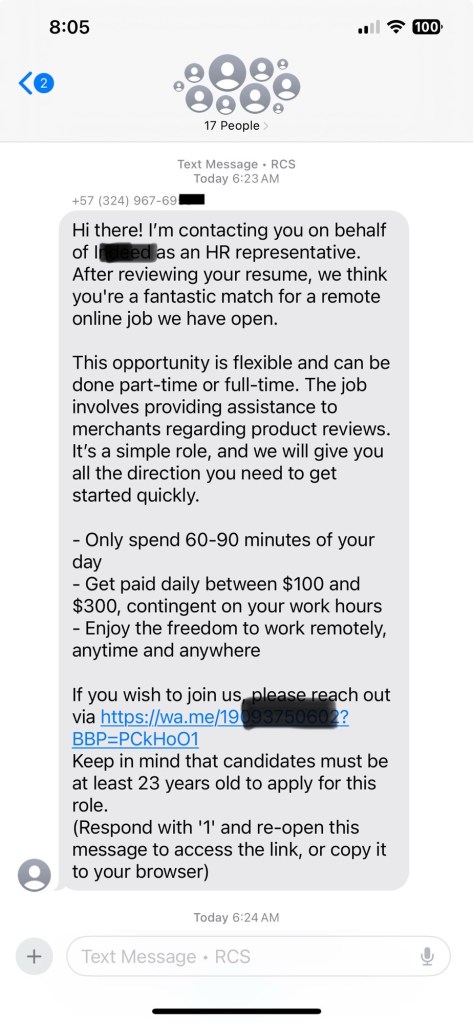
I received this message today on my phone. The company name has been blacked out of the message because I am sure it was not actually from them. This was sent in a group chat to 16 numbers, clearly meeting the definition of SPAM. The message originated from a number in Colombia (+57 country code) but was sent to 16 Canadian phone numbers. FWIW, I received this 3 times from 3 different Colombian numbers to different sets of Canadian numbers. In total, I counted 46 CASL violations in 15 minutes.
So I did what everyone should do – I reported it. In the US and Canada, you can forward these messages to #7726 and your carrier will relay those messages along with the originating number to the proper authorities. In Canada, that authority is CASL and the fine can be $10million. You could alternately use the CASL reporting form here. Forwarding a text message can be tricky, so I took a few screenshots to explain exactly how to do this on an iPhone.
First, go to the message, then press and hold the actual message bubble to get the options menu. Click “More…” and you will see a forward arrow appear at the bottom right of the screen.
Click that arrow and put 7726 in the address field and send.
Your carrier should respond, asking you to provide the phone number or email address that originated the SPAM. Be careful to only send the number of the originator, NOT any of the other victims!
You can do this by pressing the icon of the group (the group of circles in the top left) and it will list all the numbers in the chat. The first one should be the originator.
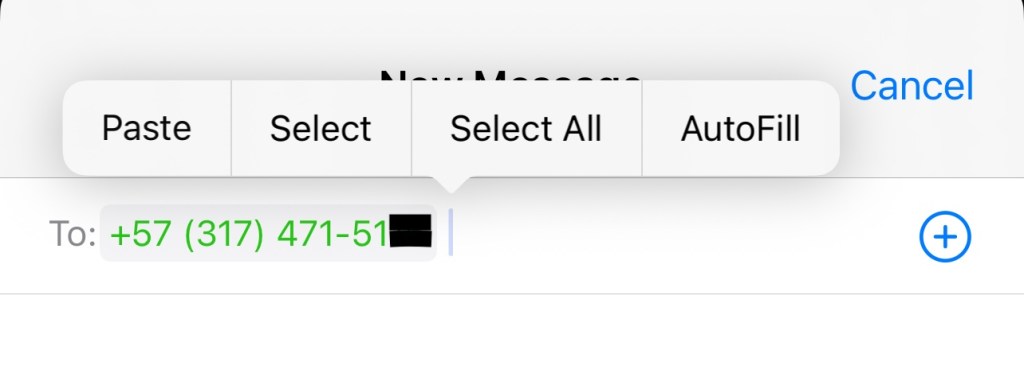
If you click that number, it will start a new message, but DON’T send it. You can just tap once beside the number, and you should get an option to SELECT and COPY it. Then you can cancel the new message. When the carrier responds, asking for the offending number, you can just paste that into the carrier chat.
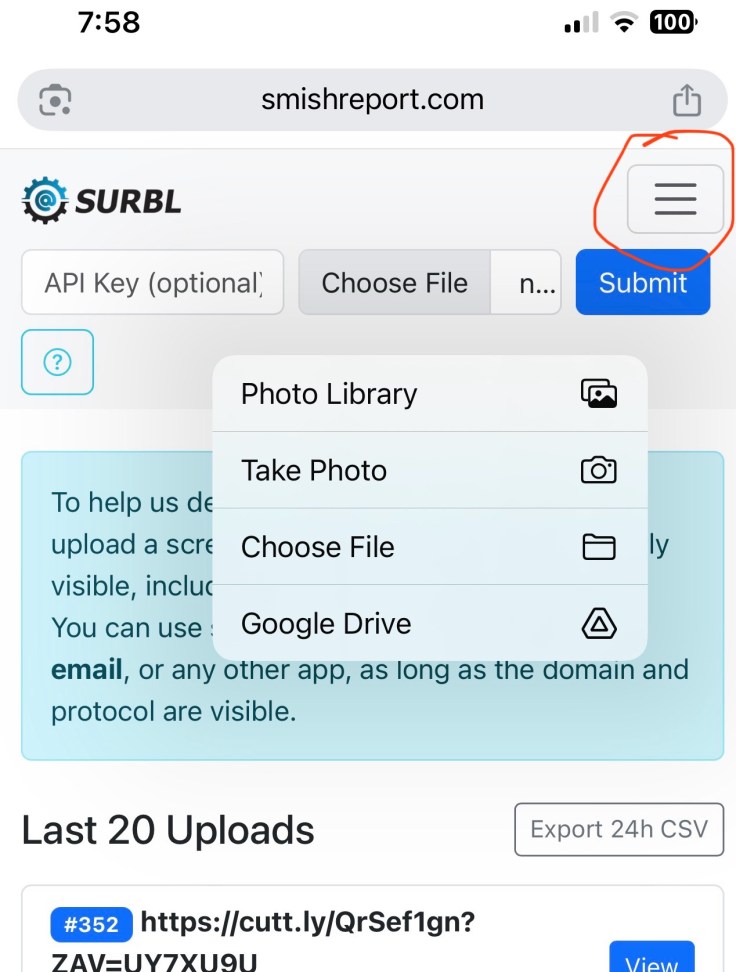
If your spam/phishing text includes a link like mine does here, my fraud-fighting friends over at SURBL would appreciate it if you helped the entire industry by sharing a screenshot of it with their “smishing” report tool. Simply take a screenshot that clearly shows the full URL ( “http : // blah.blah” ) and upload it here: https://smishreport.com/
At this point, you will likely want to leave the conversation, delete, block, and report it, etc but please do us all a favour and report these spammers. CASL actually does investigate and will indeed issue fines and penalties.
The last few weeks have been a tumultuous time in Canada. Between US tariff threats and our governing party’s internal meltdown, the country’s media outlets have had a hard time keeping up with the chaos. It is easy to see why many people have started to “circle the wagons” and shift into a protectionist mode. Frankly, I feel that is not a bad thing.
Canada has long been an open and friendly place to our neighbours near and far. As someone who has traveled extensively, I have always found that people I meet in other countries always have warm thoughts and positive comments when they hear I am Canadian. For some time, I always carried extra Canada flag lapel pins with me because people would ask for them in passing. Our welcoming global posture and history of peaceful interactions have earned us a special place in the hearts of most of the world. But that posture has also meant a lax border presence, reduced funding for security and a propensity toward oversharing. Having the largest undefended border in the world was considered by many as a benefit of the close, friendly and open relationship we have had with our closest physical neighbour. Unfortunately, when your BFF suddenly decides to instigate a trade war, those tight relationships can become a tangible problem.
It remains to be seen if Margaret Atwood’s vision of the Republic of Gilead holds any prophetic truth for our southern neighbours. I certainly hope not as many of my favourite people are American and I do fear for their safety these days. But there is not much anyone in Canada can do about that. What is critical to the people of Canada is taking a step back and rethinking how we view this relationship and how we treat each other. To paraphrase Jean Chretien, it may be time for Plan B.
I know it is hard to hear, but the painful reality is that Trump Tariffs may be the best thing to happen to Canada in a long time. We have been lacking in border security and defence spending for far too long. We have focused on North/South trade and penalized East/West trade. We have limited our own production to appease our trading partners. We have given steep discounts on resources in the name of friendly international relations. This is a wake-up call to revisit every one of those factors and re-think them. It is time for Canada to put Canada first.
Cross-border trade agreements need to be handled by the politicians and negotiating teams that own them, there is not much that individuals like you and I can do to affect those aside from speaking out, raising your voice, and letting your local representatives know how you feel. That applies just as much to the Canada/US trade situation as it does to the BC/Alberta or Quebec/Ontario border issues. Our inter-provincial trade barriers must be eliminated if we are going to get through this.
What individuals can do is focus on Canadian producers and Canadian workers. The more we as a collective can purchase Canadian goods, the less the need to export to the US and the less tariffs will affect all of our wallets. There are some obvious things like selecting things made in Canada with Canadian materials and workers. There are less obvious things like choosing to purchase goods that are largely handled by Canadian workers.
Diamond Salad Dressing from Osoyoos, BC
Interestingly, “Buy Canadian” can be more complicated than only patronizing Canadian Companies. For instance, in the cereal industry, Canada grows and harvests the vast majority of cereal grains in North America so buying almost any cereal will benefit Canadian farmers. These grains are processed in plants in Canada and America as part of a complex international trade matrix that benefits both countries. For instance, Kellogg’s Canada employs more than 300 people in Ontario even though its parent is a US company. This kind of international trade matrix is also seen in petroleum, electricity and the cattle industry. Look for a Canadian flag on the label when buying anything.
And I think that is the key to Canadians surviving and potentially benefiting from this impending trade war. Take a few extra minutes on your shopping trip to look for that maple leaf on everything you spend money on. Double-check labels to see where things are produced. Make decisions that will benefit Canadian workers. One of the secret weapons we have in our arsenal is also one of the things that defines us as Canadians – we support each other.
For me, this time of year is about closure and renewal. It’s about traditions and family and reflection. It’s about your friends and family and friends you consider family. I like to take some time at the end of the year to reflect and plan, but I am acutely aware that it is a luxury not often easily available.
This has been an exceptionally chaotic year in our house, which may be evident from the sparseness of my blogging activity this year, and it has been challenging to just sit for a few minutes and gather my thoughts, but here we are a few days from Christmas and I finally have a few minutes of calm to write.
Usually, I like to fill the few weeks of December with as many Christmas movies and shows as possible, including some great old classics that my kids like to remind me are from “last century”. Even though I have not watched the show this year yet, the Snow Miser song has been rattling around in my head for weeks. You know the one I mean – from The Year Without A Santa Claus (1974) where Snow Miser is introducing himself.
I’m Mister White Christmas, I’m Mister Snow. I’m Mister Icicle; I’m Mister Ten below. Friends call me Snow Miser, whatever I touch, turns to snow in my clutch. I’m too much. ~ “Snow Miser” by Maury Laws and Jules Bass The Year Without A Santa Claus (1974)
This is pretty empowering when you think about it. Snow is just frozen water mist that is not even as stable as actual ice. It is fragile, transient, temporary, fleeting – and yet Snow Miser owns it like a boss. He takes the natural gift he has been given and makes it his superpower, owning it and bending it to his will. Mr. Ten Below blankets everything he sees with that fine white icy goodness that chills everything so it can be renewed when it thaws. To some it is just cold and wet and gross, but it has an important and necessary function. Its a matter of perspective.
Which brings me back to family and friends and all our weirdness and oddities that mesh together to make us a community. We all have a superpower that is important and useful and needed. For some it is buried, for some it is obvious, and many people are not even aware they have one. Like Mr. White Christmas, they may just see the immediate result, and not realize the beautiful after effect that changes the world. So go ahead Mr. Icicle, make it snow.
Regardless of how you weirdos spend the last few weeks of the year, I want to wish all of the friends in my community joy and happiness. Catch you again in the thaw.
I earned my first management role when I was in my early 20’s and thought I knew everything. I was wrong, of course, which is something you don’t realize until much later in life. I messed up many things but learned many lessons while trying to fix what I broke. One of those very important lessons was “how to hire,” and it has recently come to the forefront again. I’ve been reviewing resumes lately and was reminded of a trick I developed for this that others have found helpful – read from the bottom up.
In my previous management role, I was asked to provide some tips to other managers on finding the right people and making an effective hire more quickly. The suggestion that seemed most surprising to the HR team was my trick of reading a resume backward. I have been doing it for some time and have found it effective, so maybe if you are reading this and you are hiring, this can help you, too.
If someone is helping you with filtering resumes, make sure they also understand the rules.
1) DO NOT, under any circumstances, look at the first page or have the name or any identifying information visible for the first pass.
2) If the resumes are digital files, rename them to a file number or date so you cannot see a name, e.g., “resume_476.”
3) Agree that you will always refer to the person in the resume as “they” until you have finalized your selection.
4) If you are looking at paper copies of a resume, turn them upside down so you start with the last page first. If you are reading digital files, scroll from the bottom up.
5) Consistently read and take notes from the bottom up.
This removes the tendency to bias your decision based on identifying information. A name can skew your sentiment based on assumed sex, ethnicity, and age, which are often factors that are irrelevant to the ability to do a job. As much as we all want to think we don’t have this bias… we do.
Let’s try an experiment. Think of three people, Harold Smith, Tenisha Ussabei, Takashi Ono. By the time you finished reading that sentence, your brain had created an image of each of them based on your own personal experience, and now your ability to make a sane decision has been tainted by cultural bias. No matter how hard you try to ignore it, those mental images are going to affect your decision in some way. This is precisely why I do everything I can to avoid reading names until I have already narrowed down candidates based on skills.
When you read from the bottom up, you start with “hobbies” and “volunteer work.” This is the part that candidates tend to think of as the leftover bits, but they may actually be one of the most important things to consider. If you are looking for someone who will dig in and give 110% just because it is the right thing to do, then the person who volunteers at the local Food Bank or the Boys and Girls Club is probably the person you want on your team.
The education section is usually pretty black and white – either they have the education you require for the role, or they don’t. However, seeing the “other” training that can be good character indicators is always valuable. Someone with a BSc/CompSci degree might fit your needs, but so will the other 12 candidates who have the same degree. The one with additional business, psychology, or art credits may prove to be more valuable, depending on the role you need to fill.
Working up, the next section typically includes the oldest work experience, which is often “waiting tables” or “Grocery store clerk.” I have always found that the people most capable of working calmly through tough customer support issues are the people who got their start in service industries. Working in restaurants, sports venues, retail, and tourism can provide valuable lessons in providing great customer service under extreme pressure. By the way, tip your waiter.
By the time you get halfway up the list of education, you are starting to see relevant current experience for this particular job, but you are also seeing the natural chronological work history. It always seemed odd to me that resumes list history in reverse order – I want to read the story of who this person is and where they came from. Keep working up to the most recent experience to see if they might actually have the expertise you need for this job. I know this will seem backward to the concept of filtering based on current skills, but I have found that character is more important than current knowledge. The reality is that you will have to retrain this person on YOUR current tech anyway, and who they are as a person will be much more important than their GPA in coursework that was obsolete 3 years ago.
Now, at this point, you have a good feeling about who this person is and what shaped them into the person they are today. For me, an ideal person might have waited tables through college and volunteered at the local youth center. They likely still coach youth sports, volunteer at the food bank and play shinny hockey on the weekends. They earned the degree you need to prove skills but also took extra credits in something creative. This person should have a work history and life story that looks like they had to work for it and enjoyed the ride.
And ideally, you STILL don’t have a clue as to sex, race, or age indicators that could skew your thinking. This is the point where I filter into possible candidates and rejections. It’s a sad moment, but it has to be done. Now you can finally scroll up to look at their location, availability, and name.
An important side note here is that this is entirely contrary to some common HR practices that involve hiring quotas based on sex, race, and age that I find pretty abhorrent, but if your company insists on these limitations, have someone else pre-filter resumes that fit that criterion first and save yourself some time. My personal experience is that the right skill sets exist across all demographics, and if you avoid your cultural bias, you will naturally build a diverse team.
Fat Tuesday. Mardi Gras. Pancake Day. Shrove Tuesday. Whatever you call it, today is the day you get to celebrate to the fullest and consume tasty, fatty foods like pancakes smothered in butter and syrup (yum). For Christians specifically, it marks the last day of Shrovetide, filled with celebrations of all the riches we have and enjoy before the season of Lent begins. For those unaware, Lent is a period of sacrifice, grieving and reflection that Christians observe leading up to Easter.
So what does this have to do with business?
I have been around long enough to have seen many startups succeed and even more fail, and in many cases, I believe you can often pin the ultimate reason on a lack of self-awareness. This is a good time of year for business leaders to take stock of all the thick, buttery goodness in the business they have created and revel in their achievements. But this is also a great time of year to stop and reflect on what could have been done better, where they can trim things out, and what sacrifices they should implement to make their organizations even better. The winter holidays are over, the festivities are ending, and it is time to hunker down and focus on efficiencies.
It is very easy to get wrapped up in a cycle of celebrating successes without taking into account places where improvements can be made. While this may seem like a great way to raise spirits and encourage more work, there is some valuable therapy in embracing your faults and paying some penance for errors and misalignment. Taking a step back to re-evaluate before moving forward again is critical to any successful business.
So eat those pancakes and enjoy Mardi Gras, but be prepared to wake up tomorrow and deal with the missteps, errors and gaps that need attention. Knowing these things will make next year’s celebration all that more powerful.
Listening to The Pogues Fairy-tale of New York this week, one of my favourite modern Christmas songs, it struck me how life changes from year to year and the Christmas season can change in tone as your life and the people around you evolve. And as much as that couple had a roller-coaster experience, the choir and the bells remained a joyous constant.
The boys of the NYPD choir Were singing Galloway Bay And the bells were ringing out For Christmas Day
~ Fairytale of New York by The Pogues
I love to surround myself in light and music and Christmas smells for the whole month of December and it is always a disappointment when it all goes back into boxes in January. As with every year, this December has been a little different, having been “funemployed” for nearly a year now. Just like it was different when we were first married or when we had toddlers experiencing Christmas morning for the first time. It all changes, yet there are joyous constants that persist.
There is the ornament from 1985 that always goes on the tree in a prominent place. And the handmade stockings that we have used for decades. There are the old Christmas movies that are traditional requirements, and the annual cookie decorating day when I handcraft about 20 kilos of royal icing.
My wish for you all this Holiday season is that you are able to find joy and share it with family and friends and friends you consider family. Whether that is lighting a menorah or singing Christmas carols or waiting by the fire for the Yule log to be consumed.
In my house, that means Merry Christmas, Joyeux Noel, May the blessings of the season be with you.
A year ago, I was “Head of Email Solutions” at the company formerly known as SparkPost. At least, I thought I was.
Exactly one year ago, I rolled out of bed around 6:30 AM, and did my cursory check for critical messages that might have happened overnight on my phone. I know a dozen people will tell me that is unhealthy, but that is the price when you manage a global team of top performers. The message I read shocked me awake very quickly.
“Hey, you probably already know, but I’ve been let go. It has been great working with you”.
I immediately texted back with a “WHAT? Wait – let me go find out what is happening”.
But I found that I was unable to log in to my work computer. Checking my personal email, I found a termination letter that was time-stamped early in the morning while I was sleeping. Talk about shooting an unarmed man in the back.
I was able to sync with others through some personal cell numbers and found that most of my team and several others, about 240 of the best email professionals in the industry, had been terminated by email overnight.
How rude.
The next few days were a blur of helping my former teammates get their lives sorted and then trying to figure out what my own next move was going to be. I know I am inviting ageism, but I have to clarify that I have been employed steadily in some way since 1985 and have not had any experience being unemployed, even for a day. This was life-altering, to say the least.
But that week passed, and then the next, and life moved on. I had time to reset and figure out how to reconfigure my life since this was the first time in decades I had not routinely put in 20-hour days. I settled into a new and better routine that is healthier, gives me more time with family and also lets me rebuild the consulting business I set aside to join the amazing group of people at Message Systems back in 2008.
It took me nearly eight months to really recover from that trauma and actually move forward. I’m not sure companies should be allowed to cause that much pain to hundreds or even thousands of employees all at once without some significant penalty. I know several of my coworkers have found new homes, but many have not and I would vouch for any of them any day. (Call me if you need a reference)
For my part, that recovery journey led me to KumoMTA, which started as an interesting project in February but became a full-time commitment by July, and I have not looked back since. I can only hope my old teammates find their own path to joy in this new world.
























 The Bleeding Edge