A boy and his dog

I picked up our dog’s ashes from the cremation service today.  Just another chore on my Saturday “to-do” list.  A matter of process and procedure, right?  It’s just a dog, right?
Asking for the box at the front counter was easy.  Filling out the paperwork was a piece of cake.  It’s all just standard process, paperwork, payment.  Just another chore.  I carried her box of ashes out to my truck and put her on the back seat – and then it hit me.  I was putting her in the back seat of the truck for the last time ever.  It took at least 10 minutes to regain my composure so I could actually drive.
What’s the big deal you say?  Why shell out another $200 for a cremation services after spending thousands in vet bills for years already?  It’s just a dog right?  We can always get another one, right?
Lets put this into perspective for a minute, and there will be many people who can relate closely to this, I know I am not alone here.  Our Jersey Girl, this dog who was now ashes in a box in the back seat, had been part of our family for fourteen and a half years.  She was an old girl, and it was her time, and she went peacefully, but none of that rationale makes this any easier.  My wife and I have been married for nearly 30 years, and we have spent literally half that time with her in our family.  She spent more time sleeping in our bed than we did.  She helped care for a half dozen children who at one time or another called our house “home”.  When a new puppy came into our lives a few years ago, she instantly adopted him and taught him how to be a good dog.  She was a teacher, a companion, a protector, and a friend.
Jersey was really my son’s dog, and they both knew it to the end.  I cannot tell you how many times I walked out of the house and just before I closed the door, said to her, “Good dog, guard the house, protect the boy”, and she did it so very well.  When he would go away for too long, she would curl up at his door or on his bed to make sure he was ok when he came home.
Protector, friend, companion, confidant, helper, and travel mate.  Pay $200 for cremation service to respectfully send her off?  Absolutely – without question.  So I put the box of ashes in the back seat and our Jersey Girl got to take one last ride in the truck – one of her favourite things to do.  
I will miss those truck rides.

Lean into fear

We all tend to avoid doing things because they seem too hard or too scary or too big.  In order to get anywhere, you need to lean into the fear and just start doing.  Toddlers learn to walk by first falling, they catch themselves falling and find they move forward.  Before you know it they are walking all over the place, one saved fall at a time.  They learn quickly to lean into the fear of falling, realizing they can catch themselves and turn it into a forward walk.  They turn failure into progress natively.  
That natural ability to lean into fear is beaten out of us through successive levels of schooling.  We are taught to follow the established rules for fear of punishment.  We are taught to draw inside the lines for fear of ridicule.  The society we have built is so entangled in the process of blindly accepting what we are taught that by the time we are old enough to venture out and become creative adult contributors, most of that unbound exploratory behaviour is deeply buried under rules, structure and fear.
The power entrepreneurs we adore all know this.  Gates and Jobs and Wozniak, Branson and Musk and Bezos and Benioff – these familiar names are in our homes and our lives because they ignored the commonly held paradigms around them and created something unusual and controversial – things that everyone said were crazy and would fail.  But not only they did not fail, their creations became the new norm.  These great thinkers were brave enough to lean into their fear, swim against the flow and power through with what they believed to be the right path regardless of what others said was “right” or “accepted”.
The next time someone tells you your idea is too crazy or too unusual to succeed, lean into the fear and just do it.  You may possibly fail, but at least you will do so on your own terms and odds are that if you truly believe in something, it will succeed no matter how crazy everyone else says it is.
  

XKCD and the Dictionary of Numbers

There are probably a few poor lost souls out there who have never heard of xkcd, so I am reposting a link to the most recent blag here as I found it simply awesome and wanted to share.  XKCD is full of humour and interesting useful things including one of my favourites, the “What If?” and in particular, “Relativistic Baseball“.  Science can be fun.

This post discusses a fantastic little Chrome extension written by Glen Chiacchieri, that helps put some context to the numbers you read on the web.  I agree with the author who said “I don’t like large numbers without context. Phrases like “they called for a $21 billion budget cut” or “the probe will travel 60 billion miles” or “a 150,000-ton ship ran aground” don’t mean very much to me on their own.“.  It is true and annoying and this little extension solves the problem nicely.  This morning as I was reading through the daily news updates, I came across this: “…employing 1,500 people [≈ population of Christmas Island (nation)].”.  That part I highlighted in red is the added clarification from the Dictionary of Numbers and it is very helpful.

While 1500 is not a hard number to visualize, 17Billion is.  So is $12 Trillion, the current approximation of the US Public debt.  Isn’t it helpful to know that $12 Trillion is also roughly equivalent to all the Fortune 500 revenues for 2011, but that is a whole other blog and conversation.

Anyway, if you are a Chrome user, I recommend heading to the Chrome store and installing this extension.  I found it useful.  Here is a convenient link to take you right there. CLICK ME
I also highly recommend making XKCD one of your common bookmarks because, well, science should be fun.

Be awesome – Change the world.

Because Chickens Don’t Drive Tractors

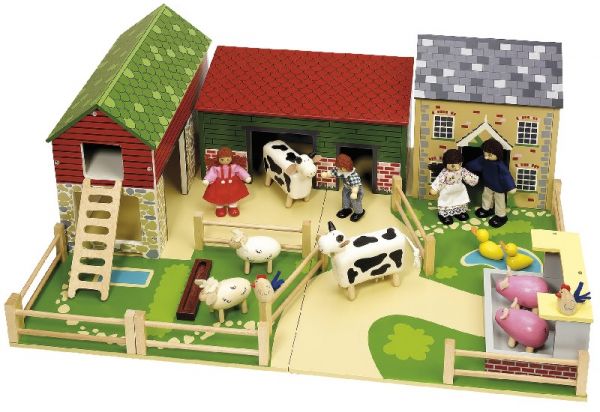
Have you ever witnessed (or been) a parent trying to explain to a 4 year old that cowboys don’t wear tiaras or that chickens don’t drive tractors?  Why interfere with that creative play in the first place?  Children learn through play and as we get older, we should continue to learn through play because it is the most efficient way to sync all your senses to one thought or concept.  Yet at some point we arbitrarily decide to tell our children that animals can not really talk, dragons only live in fairy tales and only farmers drive tractors.

Why?
Why is it so important for us to conform to a societal view of reality and shun any creative thought that conflicts with that? Why do we force our children to play and dream and be creative within hard boundaries?
We want our children to be creative as long as it is within the norm.  
     “You can colour the picture but stay in the lines.”
     “You can paint the landscape, but make sure the sky is blue.”  
     “You can play cowboy, but cowboys don’t wear tiaras.”
      But… Constrain… Shackle… Contain…
As someone who is currently sifting trough resumes trying to hire creative engineers, I am saddened by the alarming number of adults who are afraid to colour outside the lines.  I want dragon slayers and ninjas.  I want radical thinkers who are ok with chickens driving tractors.  Where are all the WIlly Wonkas?
In business  the common mantra is “think outside the box”, yet most companies really do not want that.  They want employees who will find creative ways of doing business and making money that are not the standard, but they draw the line at radical thought.  If someone who worked for you said ” hey, lets just give our product away to a bunch of people in order to drive sales revenue” you would likely think they were insane.  
Yet that is exactly what Apple did in the early 1980’s and it was brilliant.  I lived through it and even as a teenager I saw what they were doing and thought it was brilliant then too.  Give schools free computers and outfit them with computer labs.  Schools never have any money and at that time they were screaming for this new technology, yet no one was willing to provide the tools. Apple saw an opportunity to create a market and took the radical move to provide schools with computer labs at zero cost or heavily discounted rates.  IBM had a fit, but they could have never been able to make that decision to colour outside the lines the way Jobs and Wozniak did.  The result was a whole generation of children who fell in love with computers, learned how to use them and went home asking their parents to buy one. Instant market place.
Nintendo threw out the rule book with the Wii when they said “why not just make the player the controller?”.  Salesforce took on the entire software universe when they said (and I paraphrase)  “people should never have to buy software in order to use its functions”.  Netflix upset the whole movie rental industry by offering on-demand services to a central library of entertainment for the price of a single movie rental.
So there are definitely collections of dreamers and dragon slayers out there, but they are rare and I think that is because we keep telling our children that dragons only live in fairy tales.  We passively crush their creative spirit into a neat package we can cope with in our busy, professional, reality-driven lives.  Blue sky we can deal with, but pink oceans don’t make sense.  Green grass is okay, but cows with six legs are not. 
Someday some little girl or boy will grow up to become an engineer working for a company developing safety equipment for farm vehicles.  They will examine all the possible dangers but miss the fact that a chicken could possibly get into the cab and accidentally press important buttons.  He or she will miss the possibility because they they were told as a toddler playing with farm toys that chickens don’t drive tractors.
Dream, Believe, Dare, Do!

Another day, another Baktun

In spite of the best efforts of Hollywood and shock media, December 21st came and went without catastrophe  or a bang, or even a whimper.  Nope – aside from a raft of humorous Facebook posts, it was not much more that the scheduled winter solstice exactly as predicted.  So the thirteenth long-count of the Mayan calendar comes to an end exactly 144,000 solar days (a Baktun) since the last one started, and we start counting again. This marks the end of the first Great Cycle and presumably the beginning of another. I want to believe the rest of their predictions are accurate as well, in particular the regeneration of the cosmos and the re-ordering of space and time.  It couldn’t come soon enough – things have been a little chaotic lately, and not in a good way.

Really, what is wrong with people? Do we crave chaos, and drama so much that we have to twist every amazing feat of science and math into a horrific apocalyptic event?  Okay, well, I guess we know the answer to that is yes.  It is disappointing none the less to know that so much misinformation has clouded the fact that 3400 years ago, the Mayan people were able to build a calendar that accurately predicted every solar and lunar event in a repeating 5125 year time loop.  How did we miss that?  I mean as a society – how is that not the front page news?

There is a great post from NASA here with a commentary on what we should really be talking about.  The world didn’t end because that was never the plan.  The calendar did not end, it just cycled, like the one on your office wall does every January 1st. The next 5125 year cycle in our history is just a few days old now and we should be celebrating the coming of the new age.  That is not fringe level crazy talk, that is science.

As we wind down the current version of our modern Gregorian calendar and turn the page on yet another one, I have to wonder how many other ancient sciences we have dismissed and forgotten because they were not convenient to our common religious or political views.  I have to wonder if there are technologies we buried a millennia ago in favor of less accurate, but more socially acceptable ones.  Maybe this Baktun we will set things right and figure it out.

EOF

$>ReadyPlayerOne__

OMG.

I finished reading Ready Player One by Ernest Cline about one o’clock this morning and I would have blogged about it immediately if I was not seriously in need of sleep.  I just could not put it down.  I am already considering reading it again sometime this week.

This is the best cyberpunk novel I have read is quite a while and is likely the best book of any kind I have ever read.  I firmly believe Ready Player One is this generation’s Neruomancer or Snow Crash.  Like those other two icons of cyberpunk, William Gibson and Neal Stephenson, Ernest Cline has completely captured the essence of the technology revolution.   The prose is easily readable, the references are relevant and the flow is perfect – every chapter is a cliff hanger.  

I seriously could not put this book down.  At one point on an earlier evening at about midnight, my eyes were blurry and I was fighting off sleep.  Just as I was ready to put the book aside for the night I read the line:

        I lie awake, staring out at the bleakness of Megadon.  
        City and sky become one, merging into a single plane, a vast sea of unbroken grey.
        The Twin Moons, just two pale orbs as they trace their way across the steely sky. 

Recognizing the stanza above from one of my favourite Rush albums, I got up, splashed water on my face and read for another 2 hours before finally being pulled unwillingly into the realm of sleep – book still in my hand.

Cline has managed to touch on the very heart of the technology revolution – not inventing an unimaginable future, but building a realistic model based on the real events of the past.  There are hundreds of references to 1980’s pop culture, digital revolution, music, books, movies, and the general philosophy shift that was happening at that time.  That decade was a pivotal point in history on all facets and Cline has capitalized on that while speaking directly to the geeks of that generation.  From WarGames to Pat Benatar to Japanese Anime, this book touches every aspect of the 1980s revolution and does it with very close attention to detail.

That is the thing the bothers me the most about books and movies about technology – the accuracy.  When I watch a show or read a book that tries to sound technical, but their tech adviser is obviously uneducated, I get completely turned off.  Ready Player One has NONE of that, even down to the detail of serial numbers of console games.  This guy is a geek god.

If you are a geek and you lived through the eighties, drop everything and go buy this book now.  Seriously.  If you must actually walk to a physical bookstore, then do so as soon as possible, but as the book reminds us “Going outside is highly overrated“.  Even if you have never heard of Zaxxon or Qbert, if you have any interest in reading an amazingly well written book and have any interest at all in technology, then you are welcome to wait a day or so, but then go get a copy and read it anyway – you will not be disappointed.

Okay, that is enough rant … I have to go re-read that book now.


EOF__


Ode to the Dash8

This past week I was on a business trip that had me on six different flight segments.  That in itself is not all that unusual, but three of those flights were on “Dash8” aircraft.  I fly on these quite a bit and I started to wonder about the popularity of this aircraft, so I thought I would do and share some research.

I know that somewhere in my travels, I have heard that the “Dash8” (shown at left) was actually an acronym for “de Havilland Air Short Haul version 8 (D.A.S.H.8), but I have found no evidence that is actually true, however it certainly could be from the information I uncovered.  Officially the plane is called a “Dash8” because the official designation is DHC-8 (pronounced: Dee Aech See DASH eight) and it has no other nickname like most of it’s predecessors the DHC-1 through DHC-7.  The Dash8’s immediate predecessor, the DHC-7 was also referred to by a similar name, “Dash7” and was built as a commercial carrier with a very Short Take Off and Landing (STOL) capability.  Fully loaded, it could lift off in only 610 metres (about 2000 ft) which is pretty amazing for any commercial aircraft.


The earlier DHC-6 (image on right) is more commonly known as the “Twin Otter” which will be very familiar to people who often take short hauls from Vancouver to Victoria, or from Toronto to Ottawa.  These commercial “Short Hauls” are a difficult market niche for aircraft manufacturers because they have to balance agility with maintenance costs.  The Dash-7 was popular at the time, but was quickly replaced by the Dash-8 due to it’s lower maintenance costs and comparable STOL capability.  The Dash-8 can lift off in only 910 metres of runway (about 3000ft) which is considerably less than the comparably sized CRJ200 which requires about double that (1835 metres).

The “short haul” legacy of the Dash-8 has a familiar successful legacy in the DHC-5 (left) which people in forest fire territory will recognize as the “Buffalo” as well as the DHC-4 “Caribou” (shown below) that earned a place in history for short haul work supplying troops in Vietnam.


The Dash-8 actually comes in 4 distinct flavours including the popular Q400 which is actually the “Dash-8 type 400”, a 78 passenger version of the original.  Even Westjet, who’s entire fleet consists of Boeing 737’s, just placed a conditional order for twenty Q400s to add to their fleet.  Bombardier passed the 1000 unit mark of deliveries of “dash8” aircraft over 2 years ago and they still keep shipping.

An interesting note to this is that even though the Dash8-400 (AKA the Q400) is a brand new aircraft, the Dash8-100 first shipped in 1983 – Twenty Nine years ago – and many of those early birds are still in the air (I think I was on one today).

Anyway, I spend quite a bit of time in that particular make of aircraft and thought I might share some of the detail around why it is so pervasive in the short haul markets.

Hope you had fun reading about it 🙂


Managing White Space


Musicians get it.  
      Creative writers understand it.  
                   Marketing folks thrive on it.  
 
White space is a concept known in many fields for a number of reasons, but the underlying theme is always to give a mental pause.  In music, a phrase of notes, a movement, can be separated from another with a rest or a pause.  The pause gives your mind time to absorb the melody and accept a change of direction.  In creative writing, whitespace takes the form of blank lines, paragraph markers and tabs.  You can express a great deal in a written story by adding an extra blank line or space in just the right place.  Marketing people live by whitespace. This is why billboards are not crammed with images, but rather have a few select targeted images and words surrounded by clear space. Clarity. White space.
 
In the practice of people management, the concept of white space is also important.  Over the years I have made a great deal of mistakes and learned from them the hard way.  One of these things was an understanding that people need processing time, they need to gather information, sort it, sleep on it, let all the pieces fall into place.  Several times in my career, I have taken on a leadership role with a team of people who needed some redirection – usually because the company direction and goals were changing.  In these cases it is more important than ever to tread softly, but in all cases when taking on a new leadership role, it is important not to make sudden changes.  After all, the team already has one huge change to deal with  – you.
 
What I have found is that there is always some upheaval in the initial days, just because you have taken on this new role.  Even if the team knew you before, the relationship changes, the politics have to be recalculated, the pieces all need to be resorted.  What people need is some white space.  People need some mental time to process the change and understand that there is no threat to them or their families or station.  That is what it is really all about when you think about it – 60,000 years of evolution and we still think about tribe hierarchy and whether the new leader is going to cut off your head or leave you for jackal food in the desert.
 
So what to do in that first several days while you are leaving your new team with whitespace to clear their thoughts?  You ask questions, learn their strengths, research the landscape and do your best to understand the challenges that need to be addressed in the next steps.  No sane person expects a new manager to make immediate changes because that always leads to failure.  People need the clarity of whitespace in between the big announcement that you have taken on the job and the time you need to act on that responsibility, there needs to be some time for processing.  White space.
 
Another important lesson I have learned is that this pattern repeats when major changes occur even after you have been leading a team for a long time.  When there is a large adjustment to make, make it – but make it with clarity and with all the information, then leave people with time and space to process.  People need whitespace and your job as a manager it to keep it in it’s place. 
 
Be awesome change the world.

Exceeding Expectations (AKA: How to do it like Disney)

Earlier this year I blogged about my admiration for Disney and how they differentiate themselves. Having just come back from Disneyland park (yes, again) I just had to gush some more.  Before you start thinking this is going to be a long advertisement for Disney parks, I want to let you know it is actually about the concept of exceeding expectations in general.  Disney just happens to be exceptionally good at it.
There is this concept in customer service of exceeding customer expectations and it is more than just a passing fad.  Companies that do it well profit enormously from spin-off revenue, repeat business and free referrals.  There is a cost involved and many companies tend to cut corners or not really put any effort into it at all.  One company that does an exceptionally good job of exceeding expectations is the Walt Disney Company.  This is not a particularly easy thing for them since Disney has set such a high bar for excellence already that exceeding it is difficult.  However, they continue to do so and push that bar even higher.
This past week, I was at Disnelyland park in California (again) and took a series of photos of areas that the Disney Imagineers have created that were not necessary for the attraction, but only add ambiance for enhanced customer experience.  This is a key part of the concept – enhance the things that will make your customers love you even if there is no possible financial return.  Sometimes it is purely expense and the only return is increased customer satisfaction – but that is the important thing to remember.  Happy customers will talk, and word of mouth advertising like that is absolutely priceless.  The value from one good verbal, trusted referral is worth 10 billboards of advertizing.
Take a look at the set of photos below.  If you have never been to Disneyland before, these are all shots of places that are not functionally required for the attractions.  They are pathways, or sitting areas, or transitions, or even the back side of an attraction that most people never would see.  These are things that Disney could have easily NOT done and people would still pay to visit and go on rides and buy churros – but how many people would return?  Understanding that return customers are more valuable than new ones is the real key to exceeding expectations.  The incurred expense of the areas in these photos serves only to turn “customers” into “ambassadors”, but that has proven to be a valuable formula for Disney Corp.  More companies should understand that concept.

If you are a Disney nut, I challenge you to guess at where these photos were taken.  It is a fun exercise and interesting to see where Disney puts money just to enhance the customer experience. I have posted the answers on a separate page at http://mairs.ca/tom/blog11092012pics.

Be Awesome – Change the world.

Recommended Reading

I recently read “My Life as an experiment” by A.J. Jacobs and I have to say I loved it and highly recommend it to anyone interested in improving the quality of their life.  Actually, I think I would recommend this to anyone capable of reading.  This was one of the most insightful and humorous books I have ever read.  By humour, I mean laugh-till-you-fart funny.  Expelling milk through your nose laughing kind of funny.  It was not what I expected from the editor of Esquire Magazine.
In the spirit of chapter three, all about “Radical Honesty”, I have to tell my business partner and friend Mike Hillyer that when he recommended this book I was skeptical of its value and I even put off reading it several times, always finding something more important to put on my to-do list ahead of it.  I thought the title was lame (sorry A.J.), I thought the premise was weak (subjecting your life to experimentation?) and I believed there were more important things for me to be reading.   I am sorry I did now because this is one of those books that just “speaks” to you.  At least it did for me, and it did so in a very personal way.  
If you have not read it yet, I encourage you to order it, or go to the library, or borrow a copy from a friend.  The Radical Honesty chapter (“I think you’re fat”) is worth the price of admission alone, but the chapter on multi-tasking (or actually, uni-tasking) is absolutely priceless.  After reading (and re-reading) it, I am thoroughly convinced my wife needs to meet Julie,  A.J.’s wife, just to prove that I am not completely alone in my insanity.
I don’t think I will ever pretend to be a famous movie star for any period of time in order to feel the pressure of fame.  Nor will i likely get a professional photographer to capture me nude to prove a point about vulnerability.  However, I found significant vindication in the chapter “Do I love my wife” now knowing that there is indeed scientific proof of love as a bio-chemical reaction in the brain.  (I told you so.)
For the adventurous thinker, this book is a must.
Be Awesome – Change the World.

Website Powered by WordPress.com.

Up ↑